
Currency Pairs Lose Half Their Retail CFD Share in a Year
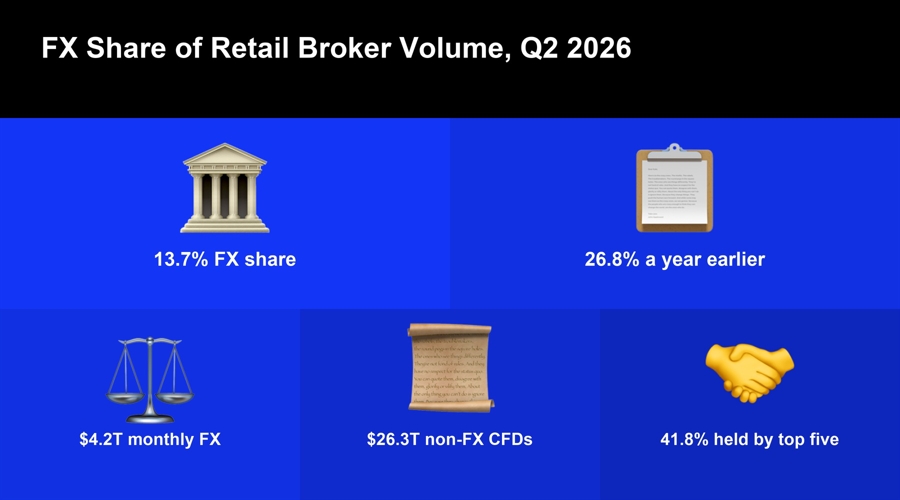
The retail CFD sector is witnessing a dramatic structural shift away from foreign exchange, with currency pairs accounting for just 13.7 per cent of reported trading volume in the second quarter, compared with 26.8 per cent in the same period a year prior, according to a new FM Intelligence report published on Monday.
In absolute terms, monthly FX volume across the brokers tracked by the research firm dropped from $6.4 trillion to $4.2 trillion over the trailing twelve months. Meanwhile, combined volume in index, commodity, equity, and crypto CFDs surged from $17.4 trillion to $26.3 trillion in the same window, meaning the industry's overall pie actually expanded even as the FX slice shrank.
The rotation is not a minor reshuffling. The non-FX asset classes are now generating roughly six times the volume of currencies, a reversal from a period when FX still dominated retail CFD activity.
Top Five Firms Consolidate While FX Exposure Shrinks
The five largest brokers by volume — EC Markets, TMGM, IC Markets, IG Group, and JustMarkets — now command 41.8 per cent of the volume that FM Intelligence attributes to named firms. Yet only 4 per cent of their combined activity is in currencies, down sharply from 10.9 per cent a year earlier.
In April, the research group had noted that the top five's collective share had remained essentially flat between the end of 2021 (38.4 per cent) and the end of 2025 (38.2 per cent), measured across a consistent panel of 51 to 52 named brokers. The latest data shows that share has climbed in each of the three subsequent quarters, indicating the concentration trend has picked up momentum.
A further commonality among the top five beyond their scale is their platform reliance: three of the firms route all of their reported volume through MetaTrader.
Industry-Wide Volume Decline Masked by Two Outliers
The rise in top-five concentration did not stem from growth at the leading firms. FM Intelligence's July ranking placed the overall industry's quarterly contraction at 9.3 per cent between Q1 and Q2. When broken down by rank tier, the median named broker shed 12.6 per cent of its monthly volume, and 47 out of the 51 firms present in both quarters reported a decline.
Two companies account for the gap between the industry-wide figure and the median. EC Markets posted a 23.6 per cent increase in volume over the quarter, while TMGM managed to hold its level steady. The remaining 49 named brokers collectively lost 12.3 per cent. Within the top five itself, IC Markets, IG Group, and JustMarkets each saw volume drop by between 11 and 13 per cent.
A companion August study examining volume per active account found that trading activity per account declined at 45 of the 51 brokers during the same period. Notably, a broker that reported a double-digit volume drop in Q2 still sat near the middle of its peer group on both the total-volume and per-account measures, suggesting the contraction is broad-based rather than concentrated in a few weak performers.
Arkadiusz Jóźwiak, Editor-in-Chief at Comparic.pl, offered a market-driven explanation for the shift. He told FinanceMagnates.com that part of the move is intrinsic to the trading cycle itself, noting that the price action attracting retail capital over the past year has been concentrated in precious metals, equities, and cryptocurrencies rather than in major currency pairs.
Methodology Caveats and Data Coverage
FM Intelligence flagged an important limitation in its analysis. For many smaller brokers, the firm estimates the FX split rather than relying on direct submissions, and it revised those estimation models in the fourth quarter of 2025. As a result, 18 brokers show their published FX share jumping from a 65–70 per cent range down to 27–30 per cent in a single quarter, an artefact of the methodology change rather than a genuine trading shift.
Even after excluding those 18 firms, the underlying decline persists. Among the 32 brokers whose FX shares moved gradually, the currency share fell from 20.5 per cent to 11.7 per cent, with 30 of the 32 reporting a lower figure. Individual examples include IC Markets, whose FX proportion dropped from 19 per cent to 10 per cent, and Saxo Bank, which saw its share ease from 22 per cent to 16 per cent.
The underlying FX figures are drawn from published quarterly tables that blend direct broker submissions with FM Intelligence estimates. The firm expanded its tracked panel to 265 brokers in June. Of the Q1 2026 data, 20 per cent is classified as verified (directly submitted) while 78 per cent remains estimated.
The full FM Intelligence analysis includes a rank-tier breakdown, a per-broker volume table, and three scenario paths for how the top-five concentration share could evolve in the third quarter.