
Record Crude Numbers Mask a Fractured Energy System
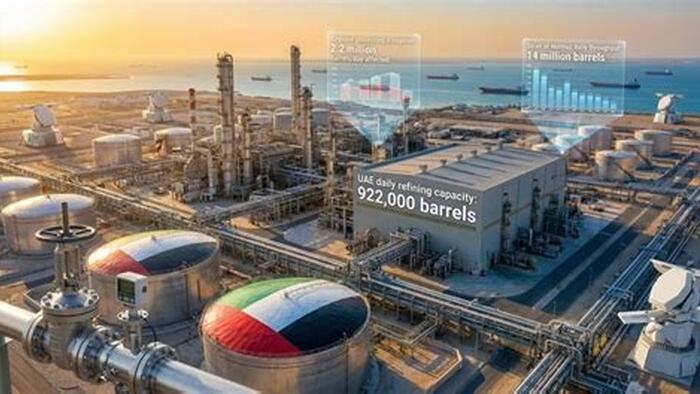
Headlines from mid-October painted a picture of full recovery for the United Arab Emirates. Citing the International Energy Agency, Bloomberg reported on October 14 that UAE oil supply reached an all-time high of 5.3 million barrels per day in September. The bypass port of Fujairah, constructed specifically to insulate the Emirates from any disruption at the Strait of Hormuz, loaded a record 2.62 million barrels per day. The Ruwais refinery complex, which had been knocked offline, was declared back at full operating capacity at the close of August.
A detailed October 22 assessment of the UAE's oil and gas infrastructure, authored by Karl Miller and published through Sonar21.com, complicates that narrative considerably. While crude exports have genuinely been restored, the gas sector continues to operate at reduced capacity, petrochemical facilities lack the feedstock needed to run at full tilt, and the fuel stockpiles designed to cushion the country against a future attack have been drawn down to roughly one-third of their prewar levels. In short, the Emirates are posting production records while a significant portion of their wider energy apparatus remains offline.
The Scale of the Damage
For years the UAE marketed itself as the Gulf's most insulated economy—stable, diversified, and largely removed from the region's recurring conflicts. The events of 2026 shattered that positioning. According to the U.S. Energy Information Administration, UAE crude and condensate output dropped from approximately 4.0 million barrels per day at the start of the year to an average of 2.4 million across March through May, a decline of roughly 40 percent.
The list of damaged facilities spans the full breadth of Emirati industry. The Ruwais refining complex was set ablaze on March 10 and forced to shut down. The Shah sour-gas plant, engineered to process 1.28 billion cubic feet per day, was destroyed in a fire on March 16. The Habshan gas complex—widely regarded as the central node of the UAE's gas network—suffered strikes on both April 3 and April 8. Borouge's petrochemical facility took damage on April 5. The Emirates Global Aluminium smelter lost power and went dark on March 28. On May 17, a drone strike hit an electrical installation that supported the Barakah nuclear power plant, an incident that would have been particularly unwelcome in any Security Council briefing.
Fujairah itself bore repeated blows. Reuters has documented at least 19 attacks on the port since the conflict began. During the week of March 16, daily loadings collapsed to 440,000 barrels. Following a strike on May 4, refined-product exports effectively halted for an entire month; in that window, a single product tanker managed to depart before June 1. The very infrastructure built to guarantee continuity proved vulnerable to the threat it was designed to circumvent.
Gas, Petrochemicals, and the Utilization Paradox
ADNOC Gas's second-quarter results, compared year on year, reveal the depth of the shortfall. Domestic gas production fell 32.5 percent. Export liquids, including LPG and naphtha, dropped 54.5 percent. The company's share of LNG output was down 63 percent. In absolute terms, export-liquid sales fell from 252 trillion British thermal units to 117, while LNG sales declined by approximately 71 percent. Revenue contracted 39 percent, EBITDA fell 47 percent, and net income dropped 52 percent—amounting to roughly $2.3 billion in lost revenue at a single entity within one quarter.
One statistic in Miller's analysis stands out for its irony. ADNOC Gas reported that its assets were 99.9 percent available during the second quarter, an improvement over the prior year. Yet actual asset utilization plummeted from 80 percent to 54 percent. The plants were mechanically ready, but the feedstock pipelines, storage terminals, and export routes they depended on had been disabled. The facilities were, in effect, fully serviced vehicles sitting on jacks with no wheels attached.
Recovery since the worst of the damage has been genuine but incomplete. Habshan's gas supply had been restored to 85 percent by August 10. Borouge repaired its plant by the end of June, only to find it had no feedstock to process, and consequently operated at 60 percent utilization. The aluminium smelter had restarted a quarter of its electrolytic pots by late August and now projects completing the full restart sometime in early 2027. As Miller notes, physical repairs tend to proceed faster than the downstream economic recovery they are meant to enable.
Depleted Reserves and a Narrow Escape Route
Perhaps the most consequential figure in the assessment concerns stockpiles. As of October 19, Fujairah held 7.25 million barrels of refined products, compared with approximately 20.7 million before the conflict—a 65 percent decline. Gasoline and naphtha inventories were down 87 percent, fuel oil down 53 percent, and diesel and jet fuel down 23 percent, with the latter category slipping a further 18 percent in a single week in October, just ahead of the winter heating season.
Fujairah is not a regional depot; it is one of the world's premier bunkering and product-trading hubs, the point at which vessels refuel and traders park cargoes between Asian and European markets. Operating at one-third of its normal inventory level means it possesses roughly one-third of its usual shock-absorption capacity. Miller's arithmetic is stark: if the Emirates lose one million barrels per day of export throughput and have only ten million barrels of usable storage to backfill, the oil fields would be forced to shut in within approximately ten days. That is not a strategic reserve; it is a buffer measured in working days.
The UAE's primary bypass for a closed Strait of Hormuz is the ADCOP pipeline running from Habshan to Fujairah. Its design capacity is 1.5 million barrels per day, stretching to perhaps 1.8 million under optimal conditions. ADNOC claims total production capacity of 4.85 million barrels per day. The escape route can therefore accommodate roughly one-third of the output the country can generate. A second pipeline is planned for 2027, a timeline that offers little comfort to anyone anticipating further hostilities in the near term.
The record September figures also warrant context. Part of the rebound reflects genuine repair work. Part reflects the UAE's departure from OPEC, which ended its production quotas in May and freed the country to ramp up output. And part, by the IEA's own characterization, came from drawing down inventories that were already at historically low levels. Liquidating existing stockpiles can produce a single month of record revenue; it does not constitute a sustainable operating model. Across the wider region, September refined-product shipments stood at 1.9 million barrels per day against 4.7 million before the war, and LPG shipments were 670,000 barrels per day versus 1.5 million.
An Unresolved Vulnerability
To be clear, as Miller himself emphasizes, no publicly available register confirms that 30 to 40 percent of the UAE's energy infrastructure remains destroyed. The recoveries at Ruwais and in crude throughput are real and should be credited. But the broader picture is unambiguous: the Emirates have rebuilt their capacity to move crude oil, while their gas sector, petrochemical feedstock chains, and above all their fuel reserves remain severely depleted.
Against that backdrop, Washington is reportedly considering another round of strikes on Iran. Tehran has already demonstrated, on at least 19 documented occasions at Fujairah alone, that it can reach the UAE's export infrastructure. The last time the Emirates absorbed a major blow, they had roughly 20 million barrels of refined products in Fujairah to cushion the impact. The next time, that buffer will be closer to seven million. Posting record output while running on empty tanks is not resilience; it is a country standing at the edge of a precipice and describing the view to the world.