Trump Signs Comprehensive Russia Sanctions Package Into Law
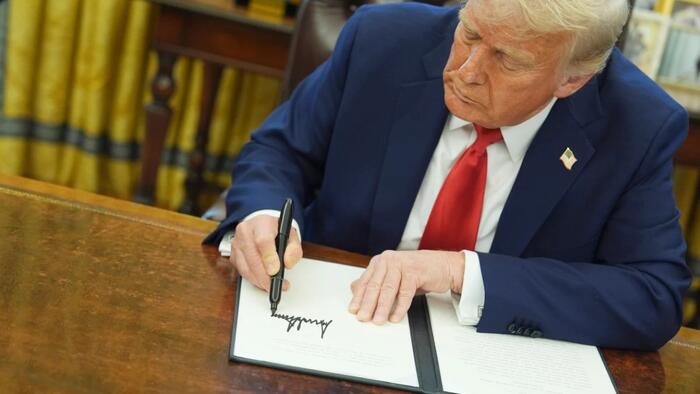
In a swift move on a busy late Friday afternoon at the White House, President Donald Trump signed a sweeping Russia sanctions bill into law, according to a White House announcement at 18:37 ET. The legislation, formally titled the Lindsey O. Graham Sanctioning Russia and Iran Act of 2026, grants the president the authority to impose tariffs of up to 100 percent on the five largest purchasers of Russian oil and natural gas.
Beyond the energy-related tariff provisions, the new law extends direct sanctions to Russian President Vladimir Putin, who the act identifies as the architect of Russia's war against Ukraine. It also targets his government officials, wealthy oligarchs, and a broad range of Russian banks and financial institutions.
The Kremlin reacted sharply to the legislation, issuing a stark warning this week that the new sanctions push the prospect of a Russia-Ukraine peace settlement further from reach than it had been in recent months.
Russia Demands Japan Remove US Typhon Missile Systems
In a parallel escalation on the Asia-Pacific front, Russia formally demanded this week that Japan withdraw US Typhon missile systems from its territory, according to a statement issued by the Russian Foreign Ministry. The demand followed another round of joint military exercises involving Japanese, Australian, and American forces in which the systems were deployed and employed.
The deployment traces back to 2025, when the US Army first announced the placement of the Typhon system in Japan, initially framed as part of a joint training exercise. Stars and Stripes reported at the time that the system was stationed at the US Intermediate Nuclear Forces (INF) Marine Corps Air Station Iwakuni, located roughly 25 miles southeast of Hiroshima. That positioning places both mainland China and portions of eastern Russia within the system's effective range.
Russian Foreign Ministry spokesperson Maria Zakharova characterized the US deployment as "unacceptable" and called on Tokyo to immediately reverse its decision and take concrete steps toward de-escalation.
"On September 3, a protest note was delivered to the Japanese side in Moscow and Tokyo over the deployment on Kyushu of US Typhon ground-based systems designed to launch intermediate-and shorter-range missiles," Zakharova stated. She added that the document specifically noted Tokyo had taken this step despite repeated diplomatic demarches from the Russian side explaining concerns about threats to national security, regional peace, and stability arising from the placement of such weapons on the Japanese archipelago.
The spokesperson further stressed that Japan's hosting of these systems is unacceptable "under any pretext, regardless of the duration or manner of that deployment," and that the Japanese side was urged to end the practice entirely and remove the systems from its territory.
Typhon Capabilities and the INF Treaty Backdrop
The Typhon system, also designated as the Mid-Range Capability, is a land-based missile launcher capable of firing nuclear-capable Tomahawk cruise missiles with a range exceeding 1,000 miles, as well as SM-6 missiles that can strike targets at distances up to 290 miles. Had the Intermediate-Range Nuclear Forces (INF) Treaty remained in force, the deployment of such a system would have been explicitly prohibited. The United States withdrew from the INF Treaty with Russia in 2019, a move that opened the door for both nations to develop and field mid-range ground-based missiles.
Putin's Statement and Broader Strategic Implications
In a separate remark addressing the Japan question directly, Putin stated: "We are not threatening Japan. We have absolutely no claims against it. On the contrary, Japan has territorial claims against our country. I mean the problem of the Kuril Islands."
The standoff over the Typhon deployment carries heightened strategic risk given a critical development from over a year ago, when Russia announced it was no longer bound by a self-imposed moratorium on deploying missile systems that had previously been prohibited under the INF Treaty. Analysts note that the Japan episode may provide Moscow with a convenient justification to accelerate its own deployment of mid-range missiles along its border regions, further complicating an already tense security landscape across the Asia-Pacific and beyond.
