
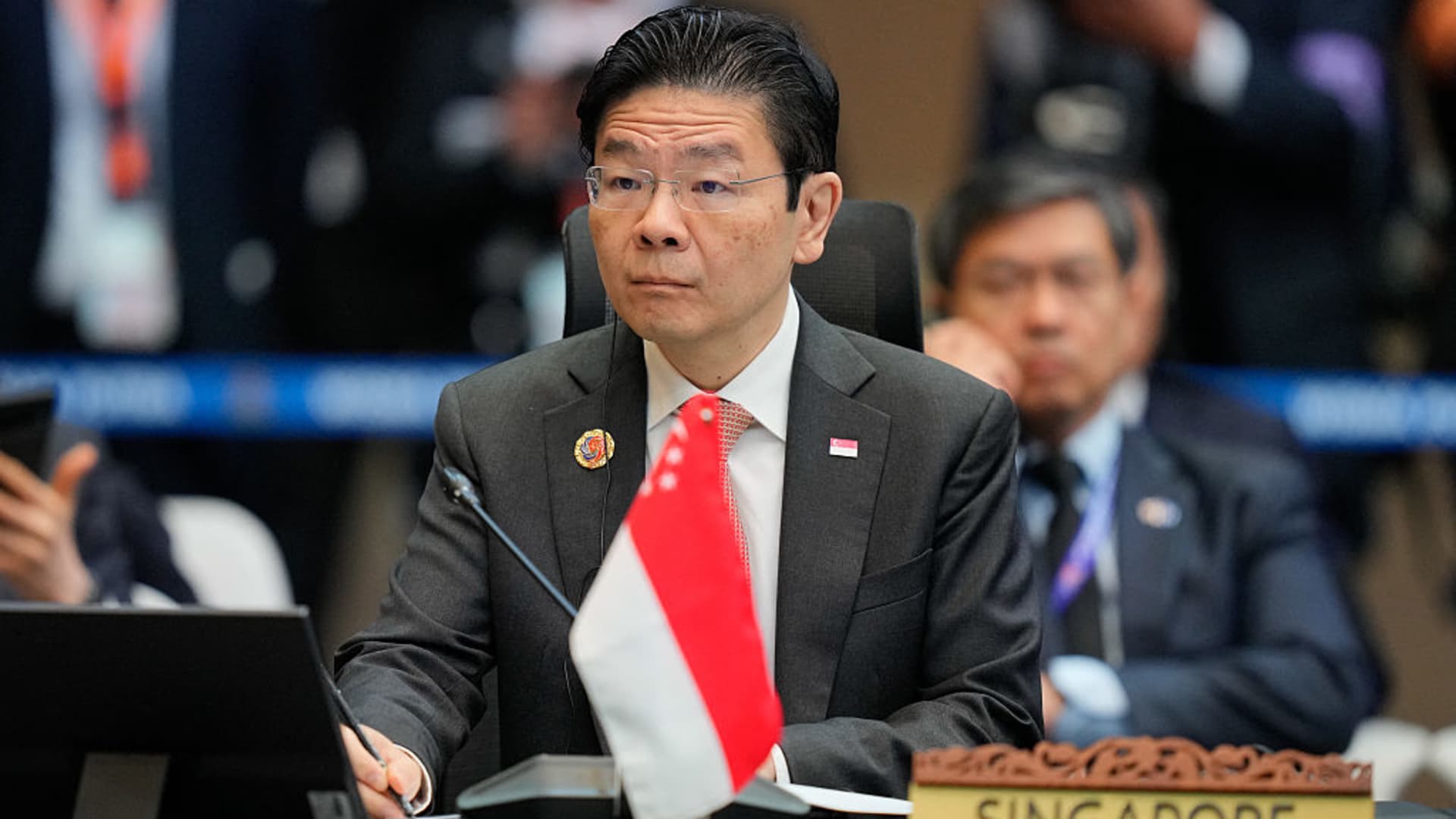
Wong Rules Out Deliberate SGD Depreciation at DBS Conference
Singapore Prime Minister Lawrence Wong publicly rejected the notion that the city-state should allow the Singapore dollar to weaken as a means of improving trade competitiveness. Speaking at the DBS Asia Future Forward Conference in Singapore on Monday, Wong made it clear that the government intends to lean on the country's structural economic strengths rather than engineer a cheaper currency for export advantage.
In a lighthearted exchange with DBS chief executive Tan Su Shan, who had drawn attention to Singapore's reputation as a global safe haven and noted that the city-state remains a comparatively expensive place in which to operate, Wong pushed back firmly. "You're surely not suggesting that we depress our exchange rate in order to be more competitive," he quipped, effectively closing the door on any policy pivot toward a weaker dollar.
Wong stressed that as long as the Singaporean economy continues to deliver solid performance, market participants should expect a strong and stable Singapore dollar that is anchored in economic fundamentals. He also highlighted the currency's role in keeping imported inflation in check, a point of particular relevance for traders monitoring SGD pairs during periods of elevated global price pressures.
MAS Policy Framework: How Singapore's Unique Approach Shapes the Forex Landscape
For CFD and forex traders, Singapore stands apart from most major economies in a critical way. Rather than steering monetary conditions through interest-rate adjustments as the Federal Reserve, the European Central Bank, or the Bank of England do, the Monetary Authority of Singapore (MAS) conducts its policy primarily through the exchange rate.
The MAS manages the Singapore dollar against a basket of currencies representing the country's principal trading partners. The exchange rate is permitted to fluctuate within a policy band whose exact parameters remain undisclosed. This framework reflects Singapore's deep reliance on international trade and imports, making currency movements a direct and immediate input into domestic price levels.
The practical implication for traders is that SGD price action tends to be driven more by trade-flow dynamics, terms-of-trade shifts, and the relative strength of the basket currencies than by conventional interest-rate differentials. A firmer Singapore dollar, for instance, lowers the cost of imported goods and services, which is a meaningful inflation buffer during periods when global commodity and input prices are elevated. On the flip side, a stronger SGD raises the effective price of Singapore-produced goods and services for overseas buyers, applying pressure to the country's export sectors.
Trade-Offs: Currency Strength, Export Costs, and the 'Not the Cheapest' Reality
Wong acknowledged the dual-edged nature of a strong local currency. He told the audience that companies seeking to export from Singapore would need to factor the currency's firmness into their cost of doing business, alongside the other structural expenses that come with operating in the city-state. "As we all know, we are certainly not the cheapest location in Southeast Asia," he conceded, a candid admission that Singapore's cost base sits well above its regional peers.
Despite that, Wong argued that competing purely on price was neither realistic nor desirable for Singapore. Instead, he framed the country's competitive edge around capabilities, institutional stability, and predictability. "Companies are not looking for the cheapest locations," he stated. "They are looking for capabilities. They are looking for stability. They are looking for predictability."
The prime minister also outlined a broader industrial strategy in which Singapore is building interconnected ecosystems that link multinational corporations with domestic suppliers, research institutions, and a skilled workforce. The underlying message for the market is that Singapore's long-term competitiveness rests on the value it delivers to businesses rather than on any relative cost advantage, and that the monetary framework will continue to support that positioning.
What It Means for SGD Traders and CFD Markets
From a trading perspective, Wong's remarks reinforce the expectation that the Singapore dollar will remain supported by fundamentals rather than being deliberately loosened for export gains. The currency has already gained roughly 0.4% against the US dollar since the start of the year, and the PM's comments suggest that further appreciation is not off the table if economic data continues to come in strong.
For CFD traders holding positions in SGD/USD, SGD/JPY, or basket-weighted SGD cross rates, the key takeaway is that the MAS's exchange-rate policy framework means the currency's trajectory will be influenced more by trade dynamics and inflation considerations than by rate-hike or rate-cut cycles. Traders should watch for signals from the MAS's periodic monetary policy reviews, shifts in the terms of trade, and the relative performance of the basket currencies when positioning in SGD pairs.
Wong's broader point—that Singapore will continue to compete on value, stability, and ecosystem depth rather than price—also has implications for capital flows. A jurisdiction that attracts long-term investment for institutional and regulatory reasons tends to see sustained demand for its currency, which can create a structural bid in SGD that is resistant to short-term speculative pressure.
In sum, the Singaporean leadership has sent a clear signal: the local currency will remain a tool for macroeconomic stability and inflation control, not a lever for trade competitiveness. Traders in the CFD and forex space should factor that policy stance into their medium-term SGD outlook.