
From Crypto Exchange Operator to Financial Infrastructure Builder
Kraken has spent roughly 15 years establishing itself as a digital-asset trading venue. Over the past two years, however, its parent entity Payward has been on a spending spree that points to an entirely different ambition. The Wyoming-registered company has poured billions into acquisitions that broaden its footprint into futures and derivatives trading, tokenized equities, and banking licenses across both the United States and Europe.
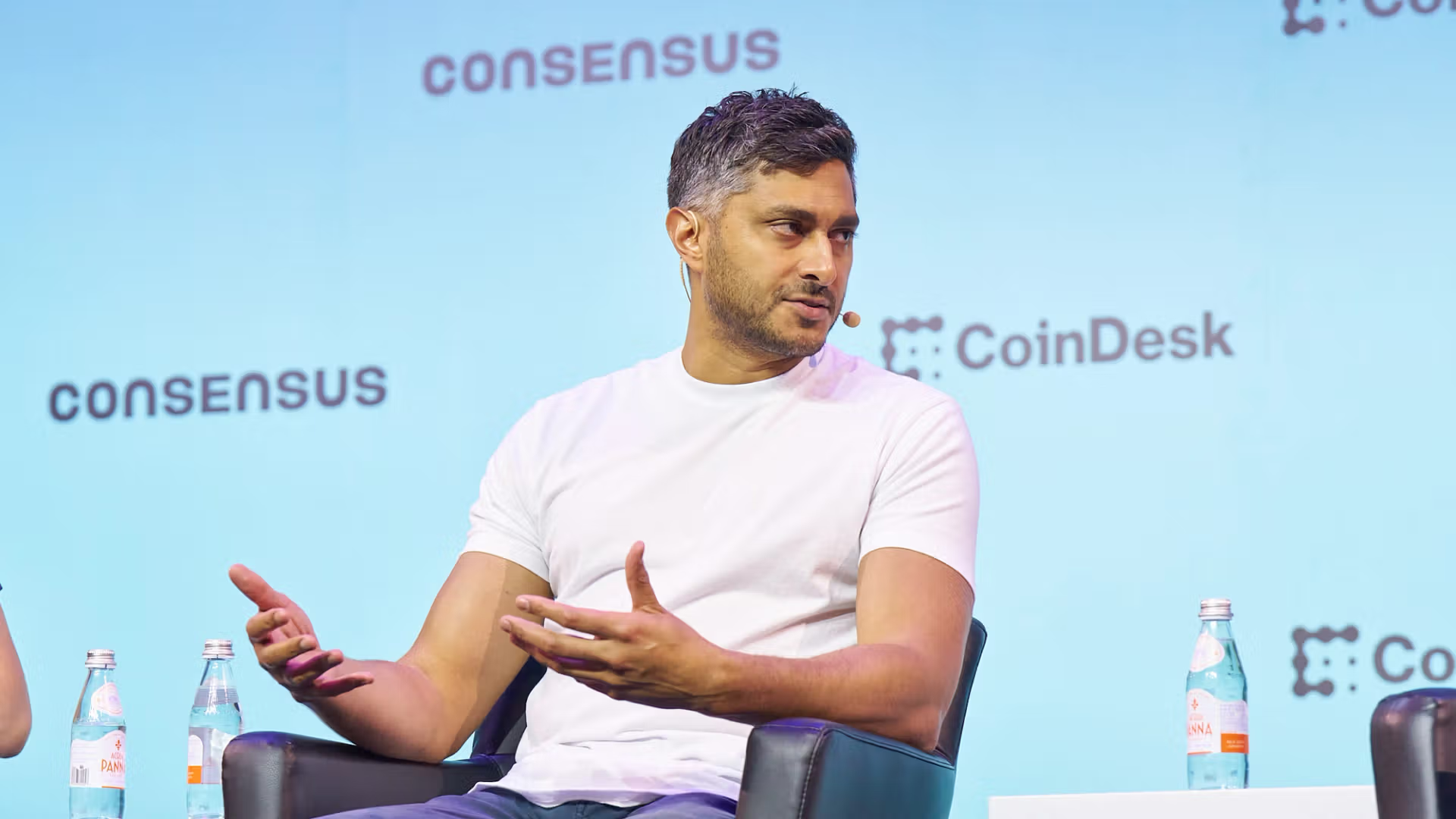
The overarching objective, as laid out by co-CEO Arjun Sethi, is to consolidate trading, banking, asset management, and business-to-business services under a single technological and regulatory framework. Sethi made clear in an interview that Payward does not see itself as a collection of separate entities. In his words, the company operates as one platform with one balance sheet and one regulatory stack, rather than functioning as a traditional holding company.
Central to that vision is what Sethi describes as a "one ledger" architecture. The idea is that money and assets can flow seamlessly between products without the web of intermediaries that currently underpins much of conventional finance. In a sector where fragmentation between custodians, clearinghouses, brokers, and banks creates delays and fees at every boundary, a shared ledger is positioned as a structural fix.
A Billions-Dollar Acquisition Strategy and Key Partnerships
Payward has not built every capability from scratch. The company has combined internal development with targeted acquisitions of firms whose technology and regulatory permissions would take years to replicate.
The most prominent deals include a $1.5 billion purchase of NinjaTrader, which gives Payward a U.S. futures brokerage along with its associated technology stack and regulatory approvals. Sethi noted that building an equivalent capability in-house would have been both costly and slow. Shortly after, Payward closed a $550 million acquisition of Bitnomial, adding a regulated derivatives infrastructure layer that includes an exchange, a clearinghouse, and a futures brokerage.
On the banking front, Sethi confirmed that Payward is "about to buy a bank in Europe," though he declined to name the target. Bloomberg reported in July that the company was in talks to acquire a Lithuanian bank as part of its continental expansion.
Not every element of the financial stack can be purchased, however. Payward has turned to partnerships with incumbent institutions whose listing and regulatory infrastructure carries decades of accumulated trust. This month, Nasdaq agreed to invest $100 million in Payward while deepening collaboration on Nasdaq Equity Tokens and market-surveillance technology. The two companies expect to launch those tokens in the second quarter of 2027, with Payward supplying distribution, trading, and post-trade infrastructure.
Separately, the London Stock Exchange has entered a partnership with Payward to explore tokenized public equities. Pending regulatory approval, the plan is to list xStocks—tokenized representations of publicly traded shares—on the LSE's forthcoming LSE 24 venue in 2027.
Sethi framed these relationships not as a concession to legacy players but as a pragmatic complement. He argued that established exchanges derive their value from trust, and that Payward's infrastructure can work alongside rather than replace their listing and regulatory functions.
Sethi also dismissed stalled U.S. crypto legislation as a barrier to progress. Payward supported the Clarity Act and has spent years engaging with policymakers, but Sethi's view is that legislation formalizes existing industries rather than creating them. He pointed out that Bitcoin has existed for 17 years without a dedicated market-structure bill, and that rights precede laws in his framework.
A Different Competitive Model: Infrastructure Over a Single Brand
Payward's strategy diverges from rivals in a meaningful way. Coinbase is constructing an "Everything Exchange" that bundles crypto, stocks, derivatives, and prediction markets under one consumer-facing brand. Binance is similarly integrating trading, payments, investing, and yield products into a unified platform.
Architect Partners, a digital-assets investment bank, characterized Payward's approach as a distinct aggregation layer. Rather than funneling all products through a Kraken-branded interface, the company is building regulated infrastructure that can power financial products across multiple brands, customer segments, and partner channels. The firm described Payward as helping define what it calls an "Everything Financial Infrastructure" model—a step beyond the Everything Exchange concept.
In terms of raw trading volume, Kraken remains smaller than its peers. CoinGecko data indicate an average of roughly $1.1 billion in daily spot trading during the first four months of 2026. By comparison, Binance held a 38.7 percent share of top-10 centralized-exchange spot volume in the second quarter, while Coinbase reported an 8.6 percent share of overall crypto trading volume in the first quarter.
Kraken itself operates at a considerable scale: approximately 6.6 million funded accounts holding between $40 billion and $50 billion in assets, spread across more than 190 countries and territories, according to Sethi.
B2B Services, Asset Management, and the Path Toward a Public Listing
Payward has organized its vision into four pillars: trading via Kraken, banking through Kraken Financial (a Wyoming-chartered special-purpose depository institution), asset management, and Payward Services, its business-to-business infrastructure division.
Around the existing user base, Payward is layering new services including cards, lending, derivatives, tokenized equities, the ability to borrow against held assets, and deployment of assets into decentralized-finance applications.
Payward Services represents a particularly significant strategic bet. The division packages infrastructure that Payward originally built for its own use—custody, liquidity, compliance, risk management, payments, and settlement—into a common set of APIs available to banks, fintech companies, brokerages, and crypto platforms. At least 25 companies are currently building products on that infrastructure, with launches expected this year. Hyperliquid is among the named partners.
Architect Partners highlighted a key implication: Payward's revenue model does not depend on end customers directly interacting with Kraken. Banks, fintechs, and brokers can integrate Payward's rails into products that carry their own brands. This opens a distribution channel and a revenue stream that is independent of Kraken's consumer trading volume, while also placing Payward in direct competition with the growing cohort of crypto firms selling infrastructure to traditional financial institutions.
On the asset-management side, Payward is formalizing its long-standing custody, staking, and yield offerings into a platform that can host additional managers, strategies, and asset classes. The initial focus is on tokenized equities, followed by structured products that can be subdivided into smaller units and distributed globally. A recent partnership with Bitwise produced an institutional investment product, and Payward expects to onboard more managers over time. Sethi described the end result as resembling traditional asset management from the customer's perspective, but executed and administered on Payward's tokenized rails to reduce costs and counterparty exposure.
Payward filed confidentially for an IPO in November 2025. CoinDesk reported earlier this month that the company does not anticipate going public before the second quarter of 2027 at the earliest. Sethi declined to discuss timing beyond what is already public, emphasizing that Payward remains profitable, revenue continues to grow, and a listing will occur when it is appropriate for the business, shareholders, and regulators.
The company does not view external capital as a prerequisite for its expansion. Sethi stated that Payward can fund investments from its own balance sheet. Recent capital raises have instead been used to bring in strategic partners whose expertise extends the platform's reach, including Citadel Securities and Nasdaq.
Financially, Payward reported $508 million in adjusted revenue for the second quarter of 2026, a 17 percent increase year over year.
The end goal, in Sethi's framing, is to use blockchain technology to simplify the financial system to the point where individual investors gain access to the same infrastructure currently reserved for sophisticated trading firms such as Jump Trading and Jane Street.