
Dollar Gains on Soaring Treasury Yields
The U.S. Dollar Index (DXY) pushed to a two-month high on Tuesday, closing the session with a 0.19% gain. The primary driver behind the greenback's strength was a sharp jump in U.S. Treasury yields, with the 10-year note yield climbing to a fresh 19-year high. This surge widened interest-rate differentials in the dollar's favour, attracting carry-trade flows and reinforcing the currency's appeal.
However, the dollar's upside was tempered by a slate of softer-than-anticipated U.S. economic indicators. August JOLTS job openings dropped by 256,000 to 7.079 million, marking a five-month low and coming in below the 7.228 million figure analysts had forecast. Separately, the Conference Board's September consumer confidence index slid 6.7 points to 81.9, a 12-year low that fell well short of the expected 89.0. On the positive side for the dollar, the July S&P/Case-Shiller composite-20 home price index posted a 0.3% month-over-month rise and a 2.47% year-over-year gain, both above consensus estimates of 0.2% and 2.20% respectively, with the year-on-year figure representing the largest increase in 14 months.
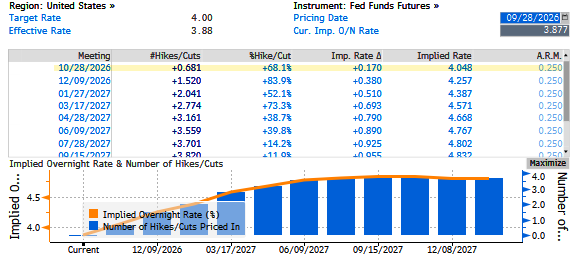
A 3% decline in WTI crude oil prices also weighed on the dollar by reducing inflation expectations and tilting the policy outlook toward a more dovish Federal Reserve. Adding to the soft tone, New York Fed President John Williams suggested that the central bank may need only a single additional rate hike to bring inflation back in line with its target. In his remarks, Williams noted that if the economy tracks broadly in line with his projections, one further upward adjustment to the federal funds range could be appropriate later this year to support a timely return of inflation to target. Market participants are currently assigning a 52% probability to a 25-basis-point hike at the FOMC meeting scheduled for October 27–28.
Euro Slides to Three-Month Low on Confidence Deterioration
EUR/USD retreated to a three-month low on Tuesday, finishing the day 0.27% lower. Broad dollar strength was the principal headwind for the single currency, but additional pressures emerged from the Eurozone data calendar. The September economic confidence indicator unexpectedly declined by 0.5 points to 97.9, missing the forecast of an increase to 99.0 and underscoring fragility in European sentiment.
The euro also carried negative momentum from Monday, when ECB President Christine Lagarde warned that rising European bond yields would constrain economic expansion and limit the pass-through of elevated energy costs into Eurozone inflation. Those remarks reinforced concerns about a stalling growth trajectory on the continent.
On the supportive side, Spain's September CPI (EU harmonized) came in at 5.0% year-over-year, slightly above the 4.9% consensus and representing the largest increase in three and a half years. Core inflation for the month rose 3.1% year-over-year, edging ahead of the 3.0% expectation. That hawkish print provided a modest cushion for the euro. Meanwhile, the day's 1% drop in crude oil prices offered a tailwind for the Eurozone economy, given the region's heavy reliance on imported energy. Traders are pricing in a 32% chance of a 25-basis-point ECB rate hike at the October 29 policy meeting.
Yen Firm as Intervention Speculation Builds
USD/JPY slipped 0.11% on Tuesday, with the Japanese yen ending the session modestly higher. A 3% plunge in crude oil prices was a key supportive factor for the yen, as Japan imports more than 90% of its energy needs, meaning lower fuel costs ease import pressures and bolster the currency. However, the simultaneous rise in U.S. Treasury yields capped the yen's gains by narrowing the yield advantage that had previously supported the dollar.
Speculation of coordinated intervention continued to underpin the yen following Monday's reports that Atsushi Mimura, Japan's top currency official, revealed the country's prime minister and finance minister, in concert with the United States, had recently conveyed a "very clear" signal regarding the yen's depreciation. Those remarks stoked expectations that Tokyo and Washington may be preparing another joint intervention to stabilise the currency.
Adding to the policy narrative, Finance Minister Satsuki Katayama reiterated that yen weakness remains a persistent concern and affirmed that Japan and the United States would maintain close communication to preserve an orderly foreign-exchange market. In related data, Japan's July leading index (CI) was revised downward by 0.2 points to 117.7 from the previously reported 117.9. Markets are currently discounting a 31% probability of a 25-basis-point BOJ rate hike at the October 30 policy meeting.
Precious Metals Post Mixed Close Amid Shifting Rate Expectations
December COMEX gold (GCZ26) closed 11.30 points higher (0.27%) on Tuesday, while December COMEX silver (SIZ26) shed 0.565 points (0.92%), touching a 1.75-month low. The mixed session for precious metals reflected a tug-of-war between headwinds and tailwinds.
On the bearish side, the dollar's advance to a two-month high and the 10-year Treasury yield's climb to a 19-year peak both pressured metals, as higher yields increase the opportunity cost of holding non-yielding bullion and signal a prolonged tightening cycle. Offsetting those negatives, the 3% drop in crude oil prices lowered inflation expectations and raised the prospect that central banks could eventually pivot toward easing, a dynamic that traditionally supports precious metals. Williams' comment that only one more hike may be needed to rein in inflation was likewise interpreted as mildly bullish for the sector, implying the tightening cycle may be nearing its end.
Institutional positioning has been supportive in recent sessions. Long holdings in gold ETFs climbed to a four-year high on Tuesday, while long positions in silver ETFs rose to a six-month high the previous week. Central-bank demand for gold also remains robust: last Monday's data showed that bullion held in China's People's Bank of China (PBOC) reserves increased by 650,000 troy ounces in August to 76.73 million troy ounces. That marked the largest single-month increase in three years and the twenty-second consecutive month of additions, underscoring the sustained appetite of sovereign buyers for the yellow metal.