
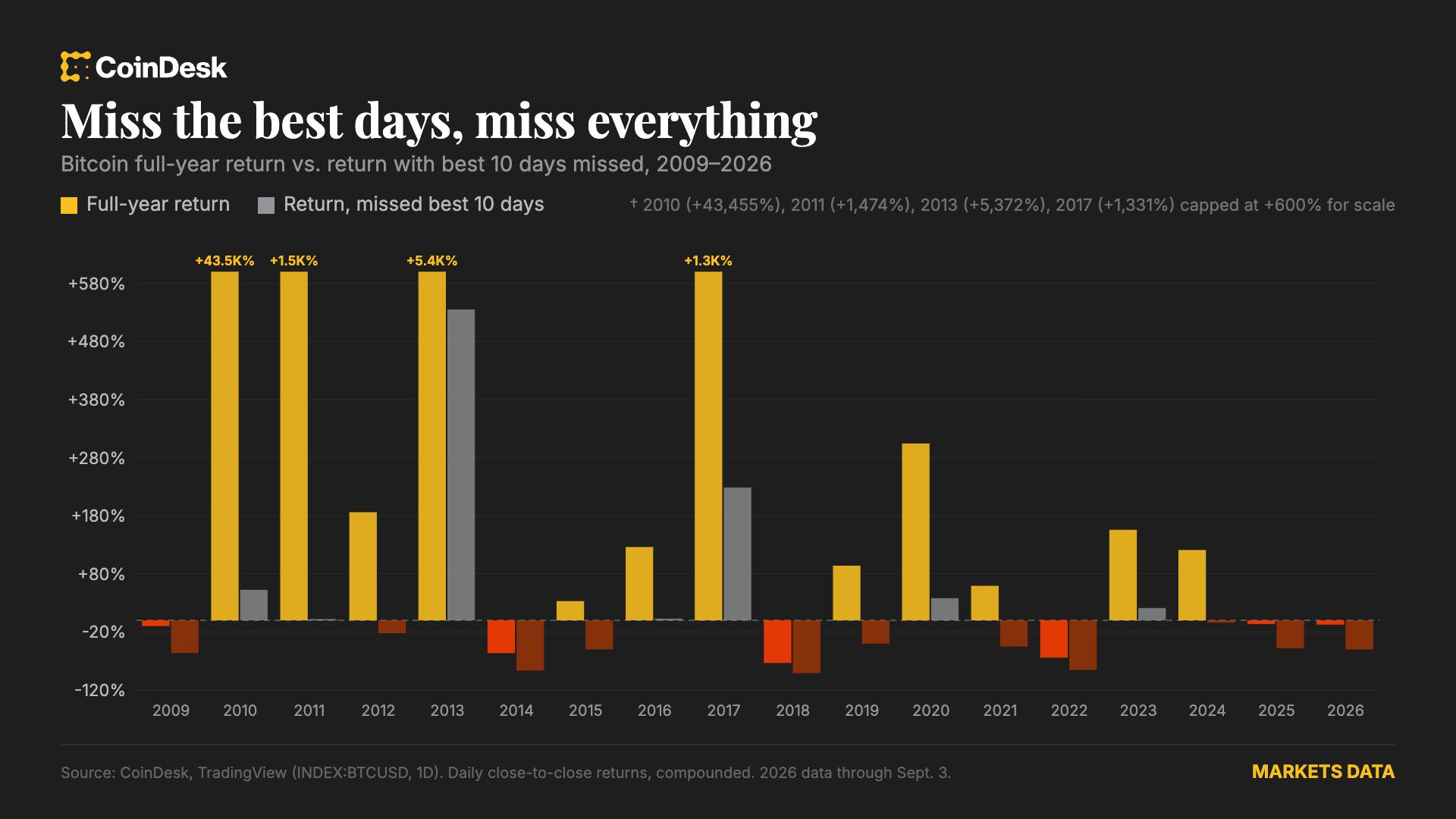
The Core Problem With Bitcoin Market Timing
For traders and investors who follow the forex and crypto markets, the temptation to time entries and exits is powerful. Yet a historical analysis of bitcoin's price performance from 2010 through 2026, as reported by CoinDesk, points to a sobering conclusion: the overwhelming share of the asset's annual returns is delivered during a remarkably small window of the year. In practical terms, that means a trader who sits on the sidelines waiting for the perfect signal will, more often than not, miss the very days that drive the bulk of the reward.
Crypto experts cited in the analysis argue that this concentration of returns makes a straightforward buy-and-hold approach not just competitive with, but clearly superior to, attempts at active market timing. The logic is straightforward: if the majority of gains land in a handful of trading days spread across a 365-day cycle, the probability of being absent from the market during those critical sessions is high. Timing, in this context, becomes a game of missing the prize rather than selecting the best moment.
What the 2010–2026 Window Reveals
The analysis covers a full sixteen-year span, encompassing multiple bull and bear cycles, the 2013 and 2017 parabolic runs, the 2018 correction, the 2020 pandemic-driven rally, and subsequent volatility. Across all of those cycles, the pattern holds: returns are not evenly distributed across the calendar. Instead, they cluster into brief, hard-to-predict bursts. This is a critical distinction for anyone building a strategy around bitcoin, because it means that calendar-based or sentiment-based timing heuristics tend to underperform a passive accumulation approach.
Practical Guidance for Traders
From a guidance perspective, the takeaway for retail and institutional traders alike is clear. If your objective is to participate in bitcoin's long-term appreciation, the data suggests that consistent buying and holding—rather than oscillating between cash and exposure—captures more of the upside over time. Active timing strategies, while psychologically appealing, carry the structural risk of being out of the market precisely when the concentrated return days arrive.
That said, this does not eliminate the need for risk management, position sizing, or an awareness of the asset's volatility. It does, however, shift the strategic emphasis: rather than asking "when should I buy?", a more productive question may be "how can I ensure I am invested through the small fraction of days that deliver most of the year's gains?" The historical record from 2010 to 2026 strongly favors the latter framing for anyone whose goal is to beat, or at minimum match, the asset's average annual return.
Bottom Line for the Guides-Forward Investor
The CoinDesk analysis reinforces a principle that seasoned forex and crypto traders often repeat: in markets where returns are highly time-concentrated, simplicity tends to outcompete complexity. Buying and holding bitcoin, according to the experts who conducted the study, is not merely a lazy strategy—it is the one most likely to capture the full spread of the asset's performance across a multi-year horizon.